iDSP
A collection of reactive material for developing DSP intuition
Welcome to the intuitive Digital Signal Processing (iDSP) collaborative project
This page gathers reactive material for developing intuition in Digital Signal Processing.
Teaching indeed is a Communication Theory problem (and also of course a matter of presence, performance, humour, feeling etc.). How to best transfer information to students through the limited capacity of the speech and visual channels? A possible answer is: by using interactive, reactive images, which bring some sort of “biofeedback loop” and quickly make abstract concepts more accessible.
The material exposed here is organized into a list of figures which are usually proposed statically in textbooks, leaving considerable mental work on the student side to go from figure to concept. For each figure, we make our best to propose pointers to:
- Reactive tools, which are the heart if the project. They are webapps which require no specific installation to run. Tools augment the figure with reactive components which involve students in the understanding of the concept. At best, tools show reactive figures with minimal preliminary comments. Explanations come later, in a pop-up “comments” box. Tools are open source.
- Videos, which show how tools can be used to activate the figure.
- Code, available for students with technical background to check how concepts are implemented and possibly build on this implementation. At best, code comes from the tools themselves (in which computational code should be isolated from graphical code)
- Papers, when available, for a deeper understanding.
This material is taken from third parties when available (with their own licenses), or built on purpose.
If you want to contribute, or make suggestions or comments, drop us a line.
Streamlit has been used for the design of most initial iDSP apps, and then transformed into html5/javascript code by AI. The latest apps have been designed directly in html5/javascript using AI, while keeping the look and feel of streamlit apps. If you want to create an iDSP app using the python StreamLit Library, or using AI, see this How-To guide.
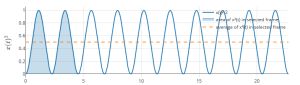
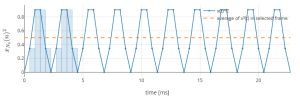
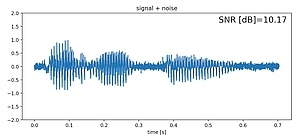
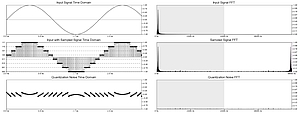
The big picture
Below is a list of concepts we hope to see someday in this project. Some are available above at the time of writing these lines. Others are waiting for some good soul to be developed and shared. This list is open. Do not hesitate to send a mail to provide your input.
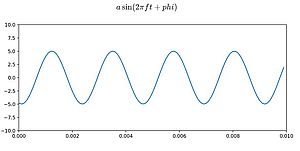
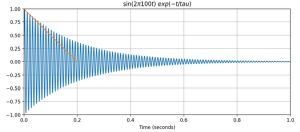
- Periodic waveforms (ex : sinus, square, sawtooth, sinc, impulse) : a, f, phi
- Power of a signal, RMS, an dBs. Link to audio norms for concerts
- Loudness. Measure perception from the listener, and apply frequency compensation on a chirp for equal loudness perception
- Simulate the audition after exposure to loud sounds without protection
- Simulate how very loud sounds are perceived when the ear distorts them (but do it on moderate loudness sounds)
- Sum of signals, including with opposite phase
- SNR on audio signals
- SNR on images
- Product of signals, vibrato, AM modulation
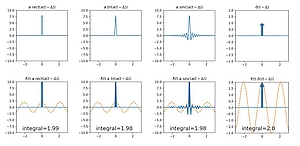
- Scalar product of signals with dirac impulses
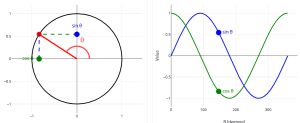
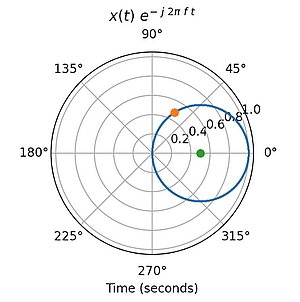
- Scalar product of signals with phasors
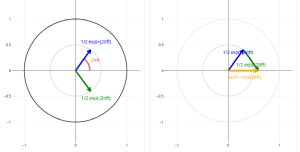
- Fourier as scalar product with phasors
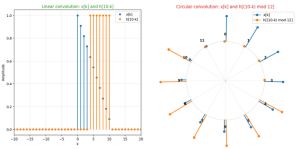
- 1-D convolution + practical application
- Convolution d’images et extension vers CNN
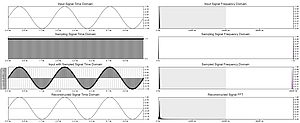
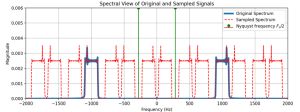
- Sampling (to be split into several experiments : sampling, aliasing, anti-aliasing filter)
- Uniform quantization (incl. dithering)
- Shannon and signal reconstruction in the time and freq domains
- Real D/A conversion : zero-hold and smoothing filter
- More complex quantization schemes (A, mu, one bit …)
- Upsampling
- Dowsampling
- Oversampling and application
- Compressive sampling
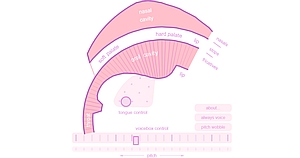
- Articulatory acoustics
- Linear prediction modeling and synthesis
- Panning, binaural phase shifting, HRTFs for audio spatialization
- Sub-band decomposition and reconstruction
- Sub-band coding, mp3
- Possibly extend to neural nets, HMMs,…
Existing material available from third parties can somehow be used for inspiration or for pointing to some demos
- Prof. Max Mignotte, DIRO, UMontréal has a great repository of Java applets (homemade or pointing to third party material)
- Prof. Daniel Russel has produced an impressive collection of Mathematica demos on acoustics (see this video for a talk by the author)
- Math and physics Javascript-based demos are available here
- Signal processing Java demos can be found here
- Reflections, is an Android App for teaching autocorrelation via audio-based short range distance measurement (includes demo videos)
- Prof A. Spanias and colleagues have developed the jDSP suite, later ported to iphone/iPAD (ijDSP, and to Android (AJDSP)
- Spectroid: a real-time spectrum analyzer on Android
- PhyPhox by TWTH Aachen, an excellent mobile lab (android & iOS). With great videos on frequency and spectrum (audio, magnetic, acceleration). GPL source code available.
- Neural Networks from Scratch in Python
- The excellent online interactive book on DSP by Jack Schaedler with brilliant interactive animations (Javascript + Observable notebook using D3 as a data graphics lib).
- Jupyter Notebooks on music processing by the authors of a very good book on the topic.
- Explained visually, with an intuitive demo of Markov chains
- Signal-related animations (in French) by Vincent Mazet (U. Strasbourg).
- Scientific animations (in French) by Geneviève Tulloue (U. Nantes)
Credits
The iDSP project was initiated by Profs. Marcelo Wanderley (IDMIL, McGill) and Thierry Dutoit (ISIA Lab, UMONS) during a 2-month sabbatical stay in Montreal (April-May 2022). Some of the material proposed here comes from the IDMIL DSP Workbench page, Neil Thapen’s game page, Jack Schaedler’s brilliant Seeing Circles, Sines, and Signals pages.